
A tile that opens another dashboard, for building your own navigation.
On this page
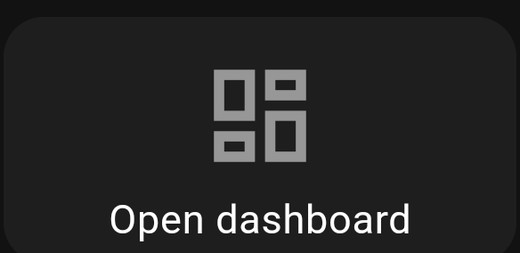
A tile that opens another dashboard. This is how you build navigation instead of putting your whole house on one screen.
The pattern
The usual structure is a home dashboard made mostly of Dashboard cards — one per room — with each room's dashboard holding that room's devices.
It scales much better than a single enormous screen, and it means each room's layout can be designed for the way that room is used.
Settings
| Setting | What it does |
|---|---|
| Dashboard | Which dashboard this card opens |
| Title | Overrides the dashboard's name |
| Show icon | Show an icon on the card |
| Show title | Show the title text |
Getting back
Opening a dashboard from a card gives you a back route to where you came from, so your home dashboard stays one tap away.
You can also set an inactivity timeout in the Settings screen, so a wall panel drifts back to the main dashboard by itself after a while. That is what makes a multi-dashboard setup work unattended — nobody has to remember to navigate home.
Permissions
If a household member does not have access to the target dashboard, the card will not open it for them. Manage this in Users and permissions.
The card is still visible to them, so on a shared panel it is worth arranging dashboards so that people are not tapping tiles that do nothing for them.
Tips
- Make them recognisable. Give each room dashboard a background image of that room. The tiles become instantly readable, even from across the room.
- Icons help too. A sofa for the living room, a bed for the bedroom — faster to parse than text at a distance.
- Custom on-tap. A Dashboard card uses the Dashboard on-tap behaviour described in the Advanced tab. Any card type can be given that behaviour, so a Device card can open a dashboard too if you prefer.